
Notary Resources and Frequently Asked Questions
Submission Requirements
Commission, Renewal, and Remote Online Notary Authorization applications must be submitted online at notary.ohiosos.gov. Use Chrome, Firefox, or Safari for the best experience.
Notary Public Jurisdiction
An Ohio notary public has statewide jurisdiction to perform notarial acts.
Notaries must be physically located in Ohio when performing traditional or remote online notarizations.
Performing notarial acts outside Ohio may result in revocation of the commission.
Remote Online Notarizations
Notaries may not perform remote online notarizations (RON) unless authorized by the Secretary of State. RON must be completed on a platform that meets O.A.C. 111:6-1-05 requirements, including:
Two-way, live audio-video communication.
Credential analysis of the signer’s identification.
Identity proofing of the signer.
Credential analysis and identity proofing performed by a reputable third party that can provide reasonable evidence to the online notary.
The notary must be physically in Ohio during the notarization; the signer may be outside Ohio.
All RON acts must be logged in an electronic journal.
Traditional vs. Electronic Notarizations
Please note that a personal appearance is always required for both traditional and electronic notarizations.
Traditional Notarizations | Electronic Notarizations |
|---|---|
Paper documents with wet-ink signatures. | Electronic documents with electronic signatures. |
Use a traditional stamp or seal and the notary’s wet-ink signature. | Use an electronic seal and electronic signature. |
Benefits of and Requirements for Keeping a Journal
For traditional notarizations, Ohio law does not require a journal; however, the Secretary of State strongly recommends logging every notarial act as a best practice.
For Remote Online Notarizations, Ohio law requires all RON acts to be recorded in an electronic journal. Per R.C. 147.65(B)(1)–(14), this electronic journal must include the following information for each online notarization:
Date and time of the notarial act
Type of notarial act
Title or description of the record (if any)
Electronic signature of each principal
Printed full name and address of each principal
If based on personal knowledge, a statement to that effect
If based on satisfactory evidence, a description of the evidence relied upon, including the issuance/expiration date of any ID presented
If based on a credible witness, the witness’s name(s)
If not performed at the notary’s business address, the location of the notarization
Description of the online notarization system used
Fee charged (if any)
Jurisdiction where the principal was located
The recording used to identify the principal, as required under division (D)(3)
Any other information required by the Secretary of State
Benefits of Keeping a Journal (All Notaries)
All notaries can benefit from keeping a journal. Doing so creates a detailed record showing the notary acted with reasonable care and helps avoid errors (e.g., forgetting to administer an oath or affirmation). A journal also helps demonstrate:
The signer’s personal appearance.
Identification method used.
Assessment of mental capacity and willingness.
Correct fee charged.
It provides a reliable record when events are challenged months or years later and deters fraud by signaling robust record-keeping.
How to Properly Perform a Notarial Act
Notary’s location. The notary must be in Ohio at the time of the notarization (includes RON).
Appearance. The signer must appear before the notary.
In person for traditional and electronic notarizations.
Real-time two-way audio-video meeting (Ohio Administrative Code 111:6-1-05) for RON.
Verify the document. Review the document to ensure the notarial certificate language is present and no required fields are blank.
Identify the signer (R.C. 147.50). Identify by personal knowledge or satisfactory evidence.
Satisfactory Evidence
Inspect an acceptable government-issued ID (passport, driver license, or government-issued ID with a photo or signature).
ID must be current or not expired for more than 3 years.
A notary may request additional information to establish identity.
Personal Knowledge
The signer is personally known to the notary through sufficient dealings to provide reasonable certainty of identity.
Require an oath/affirmation from a credible witness who appears before the notary and is personally known to the notary or identified with acceptable ID.
Note: A witness is not credible if they have a conflict of interest (e.g., direct financial interest or are a party to the transaction).
Phone identification is not allowed. A signer cannot be identified over the phone. Doing so may result in disciplinary action.
Determine the ability and willingness to sign. Do not proceed if the signer appears mentally incapable, under undue influence, or subject to coercion (R.C. 147.141 (A)(10) and (14)).
Complete the act and certificate. If the document has a certificate, confirm whether it is an acknowledgment or jurat. If it does not, the signer must choose acknowledgment or jurat, and the notary then attaches the correct certificate.
Acknowledgment:
The signer appears and acknowledges their signature.
The notary need not witness the signing.
Jurat (R.C. 147.011 (C)(1), (2)):
The signer appears, is administered an oath or affirmation, and signs in the notary’s presence.
Example oath/affirmation:
“Do you solemnly swear that the statements in this document are true, so help you God?”
“Do you affirm, under penalty of perjury, that the statements in this document are true?”
Notarial certificate must include
Required wording of an acknowledgment or jurat.
Signature and printed name of the notary.
Date of the notarial act.
Venue (state and county) of the act.
Commission expiration date (for non-attorney notaries).
Notarial seal.
Notarial Certificate Wording Requirements:
Acknowledgment: includes “Acknowledged before me” (or substantial equivalent).
Jurat: includes “Sworn to and subscribed before me” (or substantial equivalent).
Notarial Seal Requirements
The coat of arms of Ohio (¾ inch to 1 inch diameter).
The words “Notary Public” and “State of Ohio.”
Collect allowable fees.
Traditional and electronic acts: up to $5 per notarial act; a reasonable travel fee is allowed if agreed before the act (R.C. 147.08, R.C. 147.141).
Remote online acts: up to $30 per notarial act, plus a technology fee up to $10 per online notarization session (chargeable even if the act is not completed).
Notarial Certificate Examples
Acknowledgment
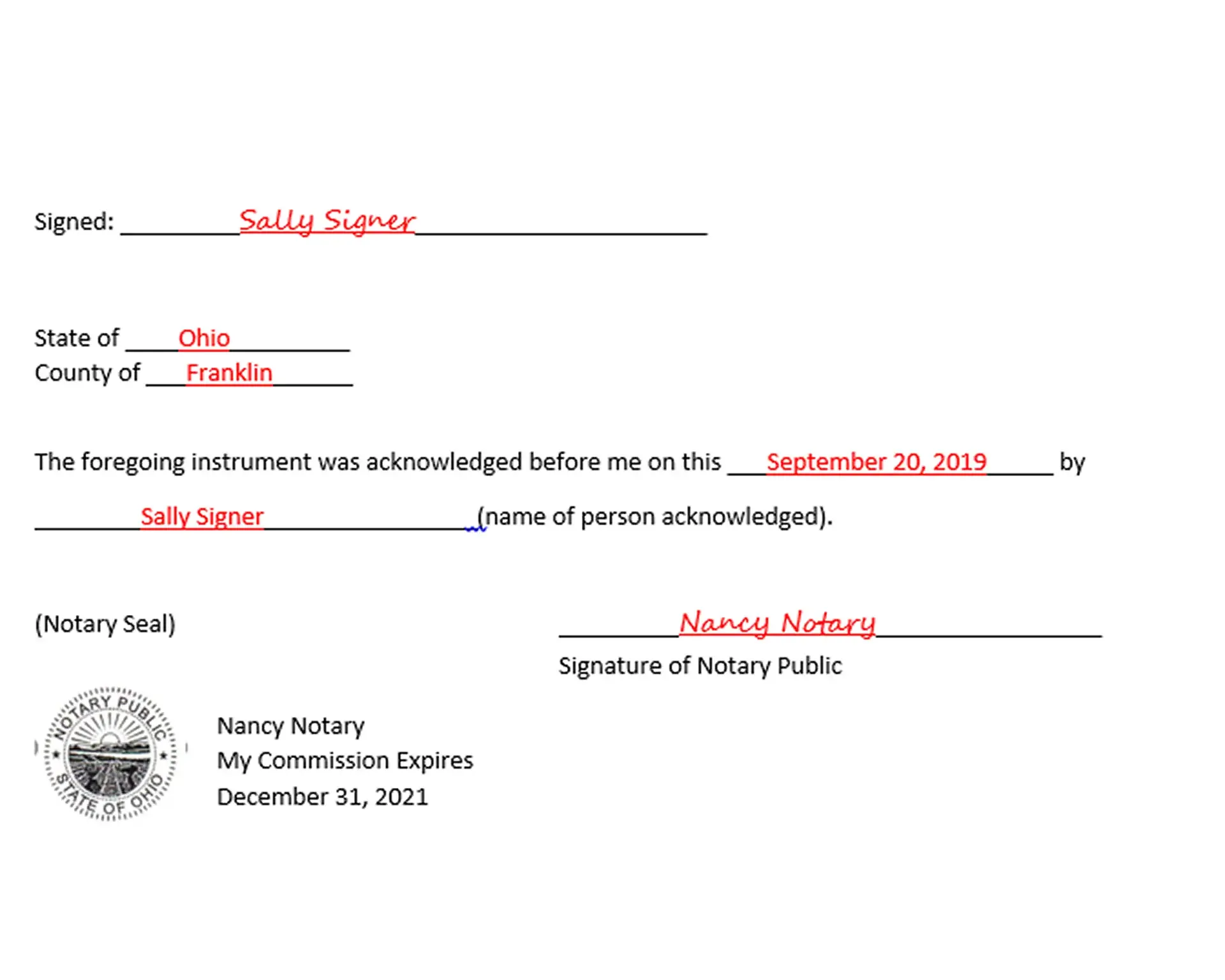
Jurat
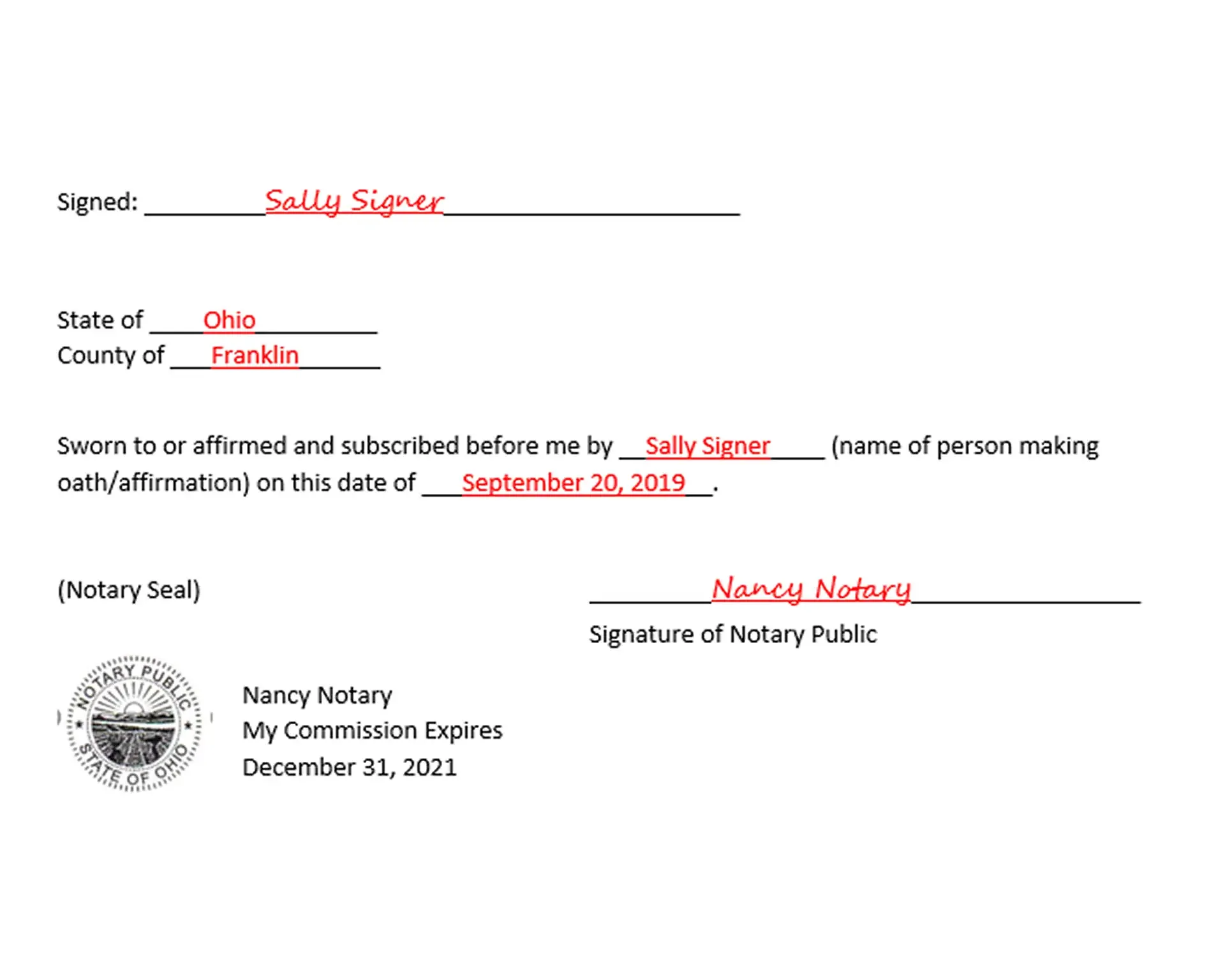
How to Notarize for a Representative Signer
A representative signer is a person signing on behalf of another person or business (e.g., under a power of attorney). When notarizing a document with a representative signer:
The representative signer appears before the notary.
Verify the document is complete (no blanks).
Verify the signer’s identity and authority (Ohio law does not require the notary to judge the legal validity of the POA).
Complete the notarial act.
Acknowledgment: The representative signer acknowledges their signature.
Jurat: administer an oath/affirmation and witness the signature.
Complete the certificate using representative capacity language. For example:
Acknowledgment: “The foregoing instrument was acknowledged before me on (DATE) by Jane Doe, attorney in fact for John Smith.”
Jurat: “Sworn to and subscribed before me on (DATE) by Jane Doe, attorney in fact for John Smith.”
Note: The signature format on the document must state the signer and the principal (“Jane Doe, attorney in fact for John Smith, principal.”).
Important: Certificates of Title
Certificates of Title generate a high volume of complaints and investigations.
Do not notarize any section of a title if any information is missing.
If a title presented to the BMV is incomplete, the BMV may file a complaint.
Common fraud risks:
The signer does not appear in person.
The notary does not identify the signer.
The title is not in the seller’s name.
Process for Notarizing an Ohio Certificate of Title
A “casual sale” is a transfer by someone other than a licensed dealer (see R.C. 4517.01 (O)). Casual sales require notarization.
Step 1: Assignment of Ownership (Seller)
Required fields (all must be completed before notarization):
Selling price
Date of sale/delivery
Consent form (if minor)
Buyer’s legal name and address
Odometer reading
Appropriate box checked
This section requires a jurat: the seller must swear/affirm that the information is true and correct.
Missing information = improper notarization and may lead to disciplinary action.
Step 2: Application for Certificate of Title (Buyer)
May not be notarized until Step 1 is completed and notarized.
Required fields:
Acceptance of odometer certification
Name and address
Purchase price and other required financial information
Vehicle information
Lienholder information (if applicable)
Consent form (if minor)
This section requires a jurat: the buyer must swear/affirm that the information is true and correct.
Missing information = improper notarization and may lead to disciplinary action (see R.C. 4505.06, R.C. 4505.07, and R.C. 147.141).
Prohibited Acts
Ohio Revised Code 147.141 (summary)
Notaries must not:
Perform a notarial act on a document executed by the notary or notarize their own signature.
Take their own deposition.
Act when there is a conflict of interest.
Certify that a document is an original or a true copy of another record.
Notarize if the signature isn’t exactly as it appears on the commission.
Use a signature stamp unless the notary has a qualifying physical disability and has filed notice with the Secretary of State (with a stamp sample).
Sign a blank acknowledgment/jurat form for later use.
Take an acknowledgment or oath/affirmation from someone adjudicated mentally incompetent when the act requires exercising a removed right.
Notarize when the person appears mentally incapable of understanding the document.
Alter a written instrument after it’s signed or alter a notarial certificate after completion.
Notarize a signature on a document that is incomplete or blank.
Proceed if the signer appears unduly influenced or coerced.
Use an acknowledgment in place of an oath/affirmation when one is required, or execute a jurat without administering an oath/affirmation.
Determine the validity of a POA or other representative-capacity instrument (unless the notary is an Ohio-licensed attorney).
Charge fees above the amounts prescribed by law.
Conflict of interest includes:
A direct financial or other interest in the transaction (beyond allowable fees).
Being named as a party to the transaction (e.g., grantor, grantee, trustee, beneficiary, lessor/lessee).
A notary may not act knowing their term has expired or they have resigned the commission.
Refusing a Notarization
Notaries are public officers and should perform lawful notarial acts. However, refusal is required when:
The signer does not appear before the notary.
The signer cannot be identified.
The signer refuses to swear/affirm when a jurat is required.
The signer appears mentally incapable or is under coercion.
The document is blank or incomplete.
The document lacks a proper notarial certificate, and the signer will not allow the notary to attach a correct certificate.
The notary has a conflict of interest.
The notary does not have their seal available.
The notary knows the transaction is fraudulent.
The signer asks the notary to certify a copy of a vital record.
The notary is unavailable (e.g., holiday, illness, or required travel outside scope).
Notaries may not refuse based on:
Personal bias (nationality, religion, race, age, lifestyle, gender, disability).
The purpose or content of the document (notarization does not equal endorsement).
Multiple edits/changes (ensure the signer initials all changes before notarization; no changes after completion).
The notary’s inability to read/understand the document.
Employers may set rules for notarial services performed within the scope of employment, but may not restrict the notary’s services outside the workplace.
Frequently Asked Questions
Yes. R.C. 2319.02 and R.C. 2935.19 require an oath/affirmation for affidavits or sworn statements (e.g., “upon oath,” “sworn to and subscribed,” “being duly sworn”).
Ask the signer whether they prefer an oath or an affirmation.
Oath: “Do you solemnly swear that the statements in the affidavit are true, so help you God?”
Affirmation: “Do you solemnly affirm that the statements in the affidavit are true, under penalty of perjury?”
No. Acknowledgments do not require an oath/affirmation.
Acknowledgment: yes.
Jurat: no—the signer must sign in your presence (see R.C. 147.53).
No. The notary must be in Ohio for all notarial acts, including RON (see R.C. 147.542, R.C. 147.62, R.C. 147.07). There are no exceptions.
No. The notary must be physically in Ohio (R.C. 147.62).
Seller must appear for the Assignment of Title.
Buyer must appear for the Application for Certificate of Title (notarized after the Assignment is notarized).
If you notarize both sections, both the seller and the buyer must appear. (See R.C. Chapter 4505.)
Not recommended. Acting as a witness may require you to sign the document, which can create a conflict of interest (R.C. 147.141).
Under R.C. 147.59, a signer may direct a designated alternative signer.
Requirements:
Signer clearly communicates intent to use a designated signer.
Designated signer appears and is identified.
Designated signer signs in your presence.
Designated signer is not named in the document.
The certificate includes the designated signer’s name and states the document was signed at the principal’s direction.
Bring acknowledgment and jurat certificates with you.
The notary attaches the correct, completed certificate (R.C. 147.542).
Notarizing without a proper certificate violates Ohio law.
No. Marriage officiants must have a minister license (R.C. 3101.08).
Yes. Age is not a barrier. You must still complete all required elements (ID, capacity, willingness, oath/ack when applicable). See R.C. 147.141, R.C. 147.50, R.C. 147.53, and R.C. 147.54.
A notarial act performed after expiration may be considered valid if proper procedures were followed; however, documents may be rejected, and acting with an expired commission violates the law and can lead to discipline and civil/criminal liability (see R.C. 147.10, R.C. 147.12).
No. Vital records are certified only by the Ohio Department of Health, probate court, or a county clerk. A signer may swear that a copy is true and correct, but the receiving entity may reject it (see Ohio Administrative Code 3701-5-02).
Employers can set rules during work hours. They cannot restrict services outside of work.
You are responsible for the security of your seal/stamp and journal (R.C. 147.01). If an employer withholds them, consider consulting legal counsel.
Only if there is no conflict of interest (R.C. 147.141). If you have a direct interest or are a party to the transaction, do not notarize.
Yes, if you can still perform all duties (ID, capacity, understanding, willingness, oath/ack when applicable).
A translator may be used; they should appear, have no beneficial interest, and be trustworthy.
Keep detailed journal notes to document compliance.